
CES Innovation Awards / 2024—2026
更新日:2026年9月26日
Updated: Sep 26, 2026
感情は、測る対象から、
システムを動かす入力へ
From Measuring Emotion
to Acting on It
CES Innovation Awards 2024–2026の1,382製品を横断し、感情・気分・心理状態などを取得・分析する技術を抽出しました。26製品を「観測 / 推薦 / 適応」で追うと、感情情報の役割が、状態を知るためのデータから、体験や環境を変えるための入力へ移りつつある姿が見えてきます。
We scanned 1,382 CES Innovation Awards products from 2024–2026 for technologies that capture or analyze emotion, mood and related psychological states. Across 26 reviewed products, the role of emotion data appears to be shifting—from something systems observe to something they increasingly act on.
01 / 時系列変化01 / THE SHIFT
2026年、適応が最大のグループになった。
By 2026, Adapt is the largest group.
感情情報を取得・推定・記録する「観測(Observe)」、感情情報から提案や洞察を返す「推薦(Recommend)」、感情情報を入力としてシステム自身が体験・環境・動作を変える「適応(Adapt)」に分類しました。年ごとの対象数が異なるため、下図は構成比で比較しています。
We classify products as Observe when they capture or interpret emotion, Recommend when they return guidance or recommendations, and Adapt when emotion becomes an input that changes the system, content, environment or behavior. Because yearly sample sizes differ, the chart compares shares.
適応(Adapt)の構成比。感情を「結果として表示する」だけでなく、次の動作を決める入力として使う製品が目立つようになっています。
Share of Adapt products. Emotion is becoming more visible as an input for what a system does next, not only as a result to display.
Observe / Recommend / Adaptはキーワードで候補を抽出後、目視にて分類しています。
Observe / Recommend / Adapt are assigned after keyword-based candidate extraction and visual review.
変化の中心は「感情認識の件数」ではなく、「感情情報を何に使うか」です。 2024年にも適応型は存在しますが、2026年では13製品中7製品が適応となり、感情がシステムを動かす入力として使われる例が最も多くなりました。
The more interesting shift is not simply how many products recognize emotion, but what they do with it. Adapt products already existed in 2024, but by 2026 they account for 7 of 13 reviewed products—the largest group in the sample.
この比率はCES全体の市場シェアや成長率を示すものではありません。公式説明文から抽出した26製品内の構成変化を記述的に比較しています。
These shares are not estimates of market share or market growth. They describe the composition of 26 products extracted from official CES product descriptions.
02 / 3段階02 / THREE STAGES
感情データが、情報から制御信号へ。
Emotion data moves from information to control signal.
分類の違いは「どの感情を測るか」ではなく、取得した後に何をするかです。同じ感情データでも、使われ方によって製品の役割は大きく変わります。
The stages are defined not by which emotion is measured, but by what happens after the signal is captured. The same kind of emotion data can play very different roles depending on how the system uses it.
感情を知る。
Know the state.
感情・気分・心理状態を取得、推定、記録、可視化する。ここでは感情は「分析結果」です。
Capture, estimate, record or visualize emotion, mood or psychological state. Emotion remains an output of the analysis.
感情から、次を提案する。
Suggest what comes next.
取得した感情情報をもとに、レポート、洞察、推薦、ガイダンスを人へ返す。最終判断は人に残ります。
Use emotion data to return reports, insights, recommendations or guidance. The user still decides what to do next.
感情で、システムが変わる。
Let the system change.
感情情報を入力として、コンテンツ、UI、環境、教育、音、香りなどをシステム自身が変える。感情が制御信号になります。
Use emotion as an input that changes content, UI, environment, education, sound, scent or system behavior. Emotion becomes a control signal.
03 / 製品例03 / EXAMPLES
同じ「感情テック」でも、役割は違う。
The same emotion signal can play different roles.
NuraLogix — Anura™ Magic Mirror ↗
30秒のビデオセルフィーから生理・心理状態を測定。Affective AIを使い、人のaffectを認識・測定・予測する例です。
Uses a 30-second video selfie to assess physiological and psychological states, an example of Affective AI focused on recognizing and measuring human affect.
inDJ — inDJ for App ↗
カメラ、マイク、GPSなどから感情状態を評価し、リアルタイムのメンタルヘルスレポートと週次のinsightを返します。感情は「理解のための情報」として使われています。
Uses camera, microphone, GPS and other smartphone data to assess emotional state, then returns a real-time mental-health report and weekly insights.
Baracoda — BMind ↗
表情・ジェスチャー・言語を解釈し、moodに合わせて照明を適応。感情情報が環境制御へ直接つながる早い例です。
Interprets expressions, gestures and language, then adapts lighting to the user's mood—an early example of emotion data directly changing the environment.
L'Oréal — Mood Mirror™ ↗
メイクを見たときの顔の動きから感情反応を分析し、喜びにつながる色やスタイルへ導きます。感情が選択支援に使われています。
Analyzes facial movement and emotional reactions to makeup looks, then guides users toward shades and styles that spark joy.
SONA AI EDU ↗
年齢・性別・感情をリアルタイム分析し、個別化した教育カリキュラムを提供。感情情報がそのまま学習体験の変更に入ります。
Analyzes age, gender and emotion in real time and provides a personalized curriculum, putting emotion directly into how the learning experience changes.
AI Turing Keys ↗
カメラとマイクからリアルタイム感情を検出し、その状態に合わせて音楽と画面上の楽譜、キー照明を生成。感情が生成体験の入力になります。
Detects real-time emotion through camera and microphone, then generates personalized music, on-screen sheet music and interactive key lighting.
Deepscent AI ↗
画像、音楽、mood、環境文脈を入力に香りを生成し、状況変化に応じて動的に適応。感情・文脈が物理空間の出力へつながります。
Uses images, music, mood and environmental context to generate scent blends and dynamically adapt them as context changes.
LG — AI-powered In-Vehicle Solutions ↗
車内カメラで視線・表情・姿勢・emotionをモニタリングし、adaptive safetyとpersonalized interfaceを支援。感情が車内UIと安全機能の文脈に入っています。
Monitors gaze, facial expressions, posture and emotion to support adaptive safety and personalized interfaces in the vehicle.
04 / 分析から見えた2つの変化04 / TWO SHIFTS
適応型の比率が、3年間で大きくなっている。
The share of adaptive uses rises across the three years.
適応(Adapt)は2024年12.5%、2025年40.0%、2026年53.8%。感情情報を取得・表示するだけでなく、コンテンツや環境、システムの動作を変える入力として使う製品が増えています。
Adapt accounts for 12.5% in 2024, 40.0% in 2025 and 53.8% in 2026. More products use emotion data not only for observation, but as an input that changes content, environments or system behavior.
感情を使う先が、体験設計へ広がっている。
Emotion data is spreading into experience design.
対象製品では、健康状態の把握だけでなく、教育、音楽、香り、車内UI、スマートホームなどで感情情報が使われています。感情データは分析結果にとどまらず、製品体験を組み立てる材料になり始めています。
Across the reviewed products, emotion data is used not only for health monitoring but also in education, music, scent, in-vehicle interfaces and smart-home experiences. It is beginning to shape the experience itself.
05 / 実験的プロダクト05 / EXPERIMENTAL PRODUCT
FamilyCardGame
感情を「場」に返すと、対面のやり取りは変わるか。
Can feeding reactions back into the table change face-to-face interaction?
CESの分析から見えたのは、感情を取得するだけでなく、その情報を次の体験を変える入力として使う流れです。FamilyCardGameでは、この考え方を対面のカードゲームで試します。
The CES analysis suggests a shift beyond simply capturing emotion: emotion and reaction signals are increasingly being used as inputs that change what happens next. FamilyCardGame tests this idea in a face-to-face card game.
本来、目の前にいる相手の表情や反応は人が直接読むものです。しかし、一瞬の反応は見落とされたり、そもそも表情に出にくかったりします。そこで現在のプロトタイプでは、顔画像から感情を自動推定する代わりに、リアクションボタンを簡易な入力として使用します。
People sitting together can already read one another's faces. But small reactions can be missed, and some people may not visibly express what they feel. Instead of automatically inferring emotion from facial images, the current prototype uses reaction buttons as a simplified proxy input.
入力されたリアクションを記録するだけでなく、システムが「何か企んでるかも…?」のような観察的なヒントへ変換し、ゲームの「場」に返します。見落とされていた小さな反応を全員の共通イベントにすることで、会話や笑い、他のプレイヤーからの反応が生まれるのかを確かめます。
The system does more than record those reactions. It turns them into light observational cues such as “Might be plotting something...” and feeds them back into the shared game space. The experiment asks whether turning a small reaction into a shared event can trigger more conversation, laughter and responses from the other players.
FamilyCardGameを開く ↗Open FamilyCardGame ↗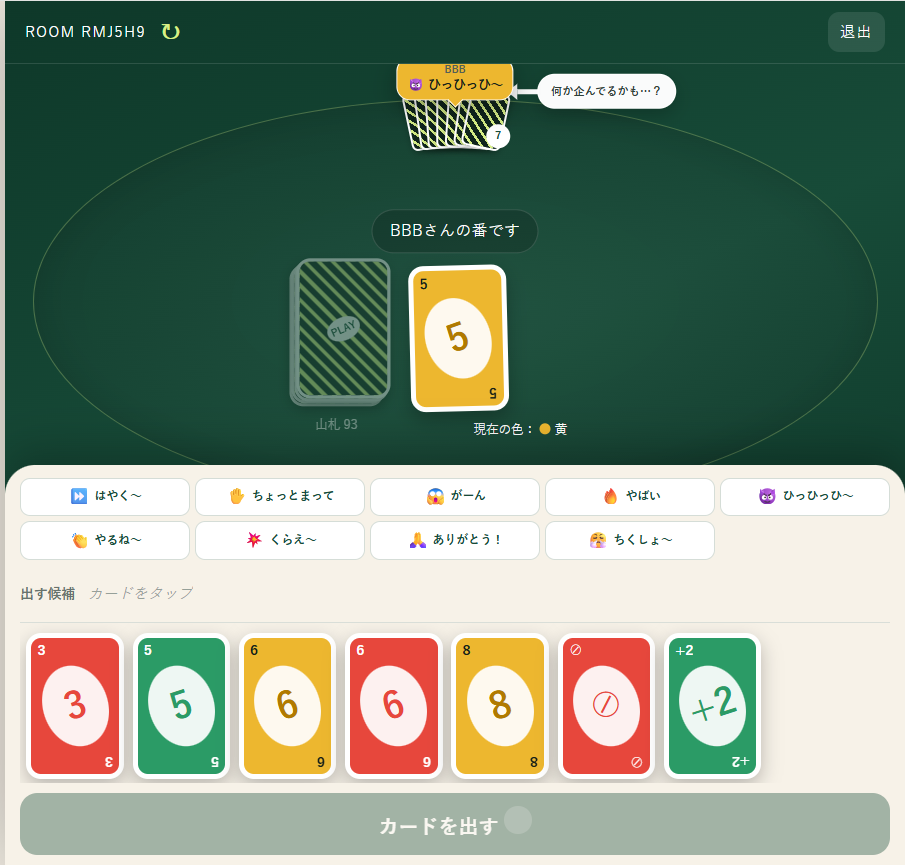
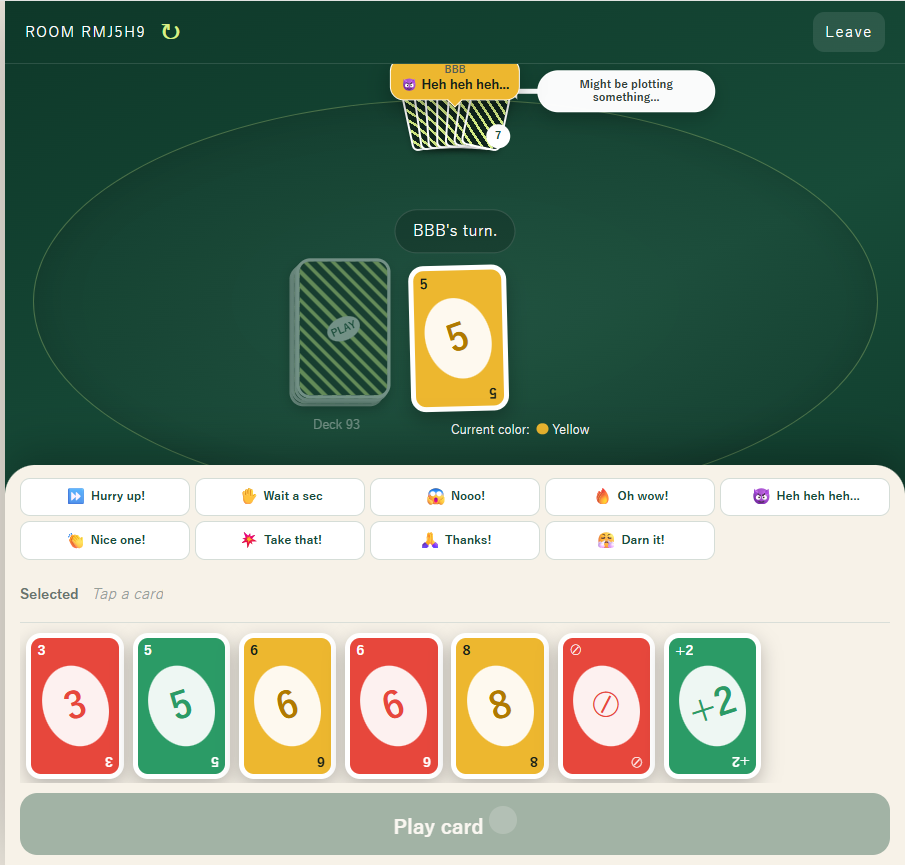
ゲームで反応が生まれる。
The game creates reactions.
カードやプレイヤー同士のやり取りによって、笑い、驚き、悔しさ、企みなど、さまざまな反応が生まれます。
Cards and exchanges create moments of laughter, surprise, frustration, anticipation and other reactions.
反応を表出する。
Give the reaction a channel.
リアクションボタンを簡易な代理入力として使います。システムを単純化すると同時に、普段は表情に出しにくい人にも反応を表出する別のチャネルを与えます。
Reaction buttons act as a simplified proxy input. They keep the prototype focused while giving less expressive players another way to make a reaction visible.
反応を「場」に返す。
Feed it back into the table.
システムが反応を観察的なヒントに変換し、全員が共有できる出来事にします。本人の言葉を繰り返すのではなく、周囲が思わず反応したくなる小さなきっかけとして返します。
The system turns the reaction into a light observational cue and makes it a shared event, giving the other players something to notice and respond to.
人間同士のやり取りは変わるか。
Does social interaction change?
フィードバックによって、声をかける、笑う、ツッコむ、相手を見るといった反応が増えるかを観察します。介入が邪魔になるのであれば、それも実験の結果です。
We look for whether the feedback leads players to comment, laugh, look up, tease, ask questions or otherwise respond. If it adds nothing—or becomes distracting—that is also a useful result.
「リアクションボタンがあると、少人数でも楽しい」という反応が初期テストで得られました。定量的な評価ではありませんが、リアクション機能が感情を記録するだけでなく、少人数の場でも発言や反応のきっかけを増やし、共有体験を活性化する可能性を示す初期観察です。
“The reaction buttons make it fun even with a small number of players.” This comment emerged in an early test. It is not a quantitative result, but it suggests that reaction input may do more than capture emotion: it may create additional prompts for interaction and make a small-group experience feel more active.
この実験で確かめたいのは、感情認識の精度ではありません。 人のリアクションを表出しやすくし、それを全員で共有できる形で場へ返すことで、対面コミュニケーションを増幅できるかを試します。現在はリアクションボタンを代理入力として、最小構成の Reaction → Feedback → Social Interaction を検証しています。
The experiment is not primarily about emotion-recognition accuracy. It asks whether making reactions easier to express, sharing them with the group and feeding them back into the moment can amplify face-to-face interaction. Reaction buttons are currently used as a proxy input to test the smallest possible Reaction → Feedback → Social Interaction loop.
METHOD / SOURCES
データと計算方法
Data & methodology
CES Innovation Awards 2024–2026の1,382製品を対象に、公式説明文から感情関連技術の候補をキーワードで抽出。用途をObserve / Recommend / Adaptへ自動分類後、目視にて最終分類しています。
We screened 1,382 CES Innovation Awards product descriptions from 2024–2026 using keyword rules, automatically staged candidates as Observe / Recommend / Adapt, and then visually reviewed the final classification.
キーワード一覧Keyword list
Emotion
emotion emotions emotional mood moods affective sentiment facial expression facial expressions psychological state psychological states mental state mental states anxiety arousal valence stress level stress levels psychological stress emotional stress
Acquisition
detect recogniz infer analyz analys assess measur monitor track estimat sens classif evaluat identif interpret captur input record log
Recommend
recommend suggest guid advis insight feedback report visualiz coach alert notify personaliz
Adapt
adapt adjust chang modif control generat trigger respond dynamic automatic actuat